FTC - PEDRO PATHING
After earning a spot in the 2026 Michiana Premier Event from the SE Michigan state competition, our team set ambitious goals for ourselves. One of those goals included implementing Pedro Pathing into our code in order to score more points during Auton. This video shares our journey learning Pedro:
What Pedro Pathing Actually Does for FTC Teams
If you've spent time in the FIRST Tech Challenge world, you've probably heard teams talk about "Pedro" the way developers talk about a favorite framework. Pedro Pathing is a Java library that handles autonomous movement for FTC robots, and it's become the most widely used path-following tool in the program.
Here's the problem it solves. During the autonomous period, a robot has to move from point to point without a driver, hit precise positions, and correct itself when it drifts off course (bumped by another robot, wheel slip, whatever). Writing that motion control from scratch is hard. Pedro Pathing gives teams a pre-built system for it.
The core idea: Bézier curves, not straight lines. Instead of programming a robot to move in rigid point-to-point segments, Pedro Pathing builds paths out of Bézier curves, the same math used in vector graphics tools like Illustrator. That means a robot can follow a smooth, continuous curve rather than stopping and re-orienting at every waypoint. The result is faster, more fluid autonomous routines.
It self-corrects. Pedro's algorithm doesn't just tell the robot where to go. It continuously checks the robot's actual position against the intended path and adjusts in real time. If the robot gets nudged off course, it corrects without a human touching the controller.
What the code looks like. Teams define a path by chaining together curve segments and heading targets, then hand it to a "follower" object that executes it:
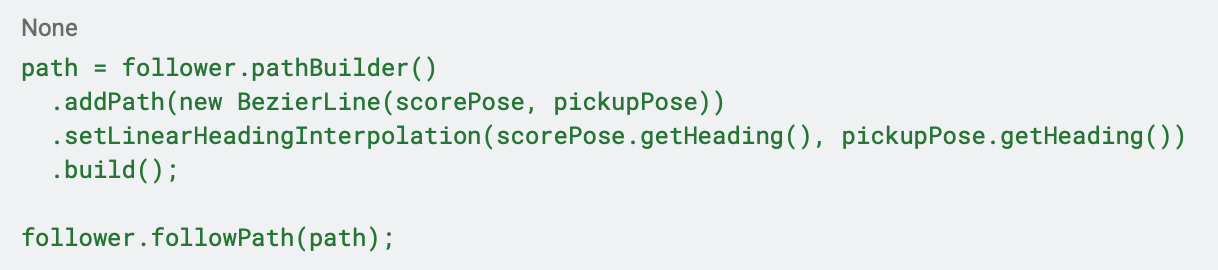
That's the whole appeal: define the geometry, let Pedro handle the physics.
Beyond the core library. The Pedro ecosystem now includes Ivy, a lightweight command-based framework for structuring robot code, and Visualizer, a browser-based tool for plotting out autonomous paths visually before writing any code. Both lower the barrier for teams without a strong programming background.
Why it's caught on. It's open source (BSD 3-Clause license), actively maintained, and has a large enough user base that documentation, tutorials, and Discord support are easy to find. For a program where teams range from first-year rookies to veteran powerhouses, having a well-documented, community-supported pathing library removes a big chunk of the technical burden and lets teams focus more time on strategy and mechanical design.
If your team is currently rolling your own path-following code, Pedro Pathing is worth a look. Full docs and setup instructions are at pedropathing.com.
Sources:
